

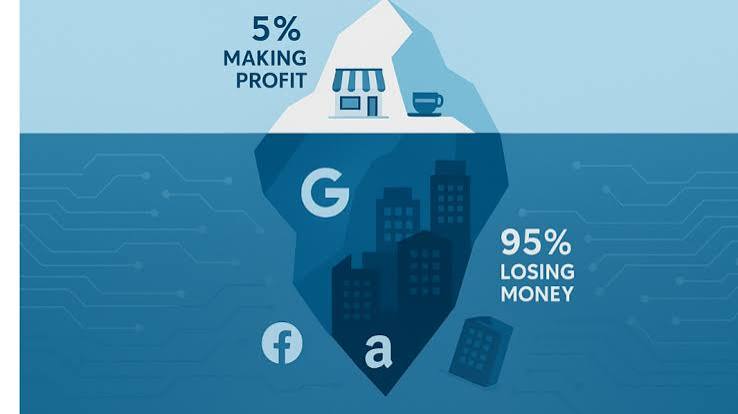
Enterprises spent somewhere between $30 and $40 billion on generative AI last year. MIT researchers studied 300 public AI initiatives, interviewed 150 executives, and surveyed 350 employees to find out what happened.
95% of those organizations achieved zero return on their investment. Not low return. Not disappointing return. Zero.
And yet 94% of those same organizations plan to keep spending. The AI budgets are growing. The results are not.
If you are a CFO, a CTO, or a CEO staring at an AI line item that has produced nothing measurable, this is for you. Because the problem is not the technology. It never was.
The Real Reason AI Projects Fail
The MIT study identified something that should make every enterprise leader uncomfortable: the companies failing at AI are not failing because the models are bad. They are failing because of how they are deploying them.
The two most common mistakes:
- 1Buying instead of building - in the wrong direction. Most organizations purchase AI subscriptions, plug them into existing workflows, and wait for results. A Copilot license here. A ChatGPT enterprise plan there. A handful of SaaS tools that each claim to "use AI." The workflow does not change. The process does not change. Only the invoice changes.
- 2Deploying AI in the wrong places. MIT found that most companies deploy AI in marketing and sales - the most visible functions, the easiest to demo, the hardest to measure in terms of real P&L impact. The functions with the highest AI ROI - supply chain, finance, operations, back-office workflows - are consistently underinvested.
The result is a company that looks like it is doing AI, without actually doing anything with it.
What the 5% Do Differently
PwC calls the companies achieving real AI returns the "vanguard." BCG calls them "future-ready." McKinsey calls them "high performers." The label changes. The pattern does not.
The 5% share three consistent characteristics:
- They engineer AI into the process - not on top of it. The difference sounds subtle. It is not. Putting an AI tool on top of a broken process gives you a faster broken process. The vanguard companies identify the process itself as the problem, redesign it around AI capabilities, and then build the solution to fit. The technology serves the workflow. Not the other way around.
- They build on a unified data foundation. Agentic AI, predictive AI, operational AI - none of it works if your data lives in six systems that do not talk to each other and nobody fully trusts by the time it reaches a decision-maker. The companies getting real ROI have invested in their data infrastructure first. Clean data. Documented lineage. One source of truth. Without this foundation, every AI project is built on sand.
- They measure outcomes, not activity. The 95% measure AI adoption - how many employees have access, how many prompts were sent, how many tools were deployed. The 5% measure business outcomes - how many hours were saved, how many errors were caught, how much revenue was protected or recovered. If you cannot draw a line from your AI investment to a number on the P&L, you do not have an AI strategy. You have an AI hobby.
What This Looks Like in Practice
One of the clearest examples of engineered AI delivering real ROI is in healthcare procurement.
A major healthcare group purchasing organization was sitting on hundreds of thousands of member purchase records - invoices, vendor contracts, product codes, spend data accumulated over years. The opportunity to identify savings was obvious. The ability to act on it was not. Manual analysis would take weeks per member. At scale it was effectively impossible.
The solution was not a ChatGPT subscription. It was not a procurement SaaS tool with an "AI" badge on the dashboard.
It was a purpose-built AI system that semantically cross-referenced every member purchase against the GPO's full catalog - matching products, identifying contract opportunities, flagging savings in real time. What previously took weeks now takes hours. The ROI is direct, measurable, and compounding with every new member added to the system.
That is what engineered AI looks like. A specific problem. A specific solution. Built to fit exactly how that organization operates.
The Question You Should Be Asking
Most organizations ask: "How do we use AI?"
The 5% ask: "Which of our processes are broken, slow, or dependent on human effort that should not require it - and how do we engineer AI into the foundation of those processes?"
The first question leads to tool purchases. The second leads to outcomes.
If your current AI strategy consists of subscriptions and pilots that have not moved a number on your P&L in the last 12 months, you are almost certainly in the 95%. Not because you made a bad bet on the technology. Because the technology was never the constraint.
The constraint is always the same: off-the-shelf tools cannot be engineered to fit a specific operation. They can only be configured to approximate one.
How to Move Into the 5%
The path is not complicated. It is just uncommon.
- Start with a process, not a product. Identify one workflow in your organization that is slow, error-prone, or dependent on manual effort at scale. Do not start with the technology. Start with the problem.
- Audit your data before anything else. If your data is fragmented, siloed, or inconsistent, fix that first. Every AI project built on bad data infrastructure will fail. Every one.
- Build for your operation, not the average one. The tools that work for 80% of companies will work for 80% of your workflows. The remaining 20% - the workflows that are specific to how your business actually runs - require something built for you.
- Measure from day one. Define the outcome before you build the solution. If you cannot define what success looks like in P&L terms, you are not ready to build yet.
- Find partners who engineer, not configure. The difference between a firm that deploys AI tools and a firm that engineers AI solutions is the difference between a contractor who installs what is in the catalog and one who builds what you actually need.
The Bottom Line
95% of companies will keep spending on AI and keep getting nothing back. Not because the technology does not work. Because they are not using it the right way.
The 5% are not smarter. They are not better funded. They are not earlier adopters.
They just stopped asking "how do we use AI" and started asking "what specifically needs to be engineered, and how do we build it into the foundation of how we work?"
That question is harder to answer. The results are not comparable.
Anterra builds AI-engineered solutions for enterprise organizations that need more than a subscription. If you have a process that is broken, slow, or dependent on manual effort at scale - we should talk.